LUCE 355-en
YEAR 64
March 2026
Magazine founded in 1962 by AIDI
Editor-in-Chief Mariella Di Rao
Clicca qui per la versione in italiano
Contacts for back issues:
phone +39 02 87389237
e-mail [email protected]
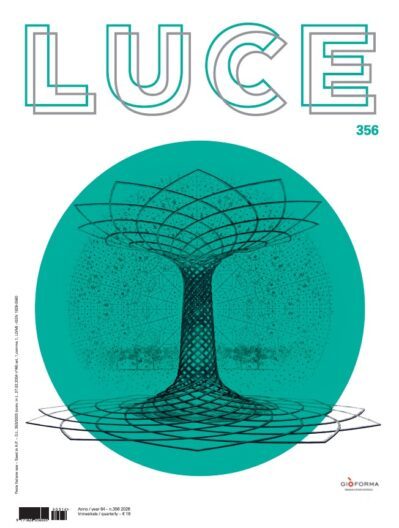
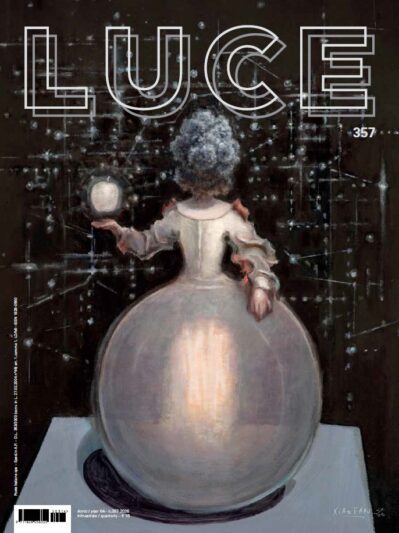
Dove la luce (Pupilla di Ungaretti), image specially designed for LUCE by the artist Fulvio Morella
€18,00
50 disponibili
In this issue:

INTERVIEWS
The Star Braille by Fulvio Morella
by Sabino Maria Frassà
We talked with Fulvio Morella, one of the most significant artists on the Italian contemporary art scene. The author of the exhibition series I limiti non esistono (Limits Don’t Exist) – culminating with Cortina di Stelle at the Museo Expo Lagazuoi Dolomiti during the Winter Olympics, where he also presented his light sculptures. His work aims to redefine the relationship between art and perception. His work spans two artistic approaches that, at first glance, appear dissimilar – though initially internationally recognised for transforming woodturning into a language of contemporary art, Fulvio Morella has since moved towards a multisensory and inclusive practice, in which Braille becomes the collective form of an accessible and shared art. An art form in which individual limitations are transformed into possibilities, and experienced with other people to the cry of “we are infinite.” The Star Braille, developed in 2022 using stars in place of dots – as if to let us “touch the sky” with your fingers – has led to his works being exhibited in some of the world’s most important collections, from the Victoria and Albert Museum in London to the Kunsthistorisches Museum in Vienna, and even at La Monnaie and UNESCO in Paris. “The Artist of the Stars” tells us here his journey toward the light and the meaning behind the cover of this issue of LUCE, titled Dove la luce (Pupilla di Ungaretti).

INTERVIEWS
Neri&Hu: “Light makes you ‘feel’ the space”
by Chiara Testoni
We interviewed Lyndon Neri and Rossana Hu, co-founders of Neri&Hu, a Shanghai-based design and research office, for whom light is never a neutral element or a technical device: on the contrary, it is a material capable of revealing spatial layers, narrative sequences, and profound connections between individuals, space, and time – because a project’s deepest meaning lies in the emotional sphere. In their view, light, as an intangible element, takes on a presence through its interplay with matter, whilst matter gains richness through light. It is precisely this tension between mass and immateriality that creates spatial layering and emotional depth. Their projects tend to prioritise density, texture and depth, where light is filtered and subdued, allowing the architecture to be experienced over time rather than “at a glance”…

INTERVIEWS
“Everything is a stage” in Giò Forma’s creativity
by Monica Moro
We caught up with Florian Boje, who, together with Cristiana Picco and Claudio Santucci, founded the design studio Giò Forma in 1998. This trio of multidisciplinary experts, with backgrounds in set design, architecture and landscape architecture, work alongside an equally multidisciplinary team to create innovative experiences and architectural narratives across a range of sectors, including show & production design, architecture, culture, music, leisure, opera, hospitality, fashion, design and entertainment worldwide, from Saudi Arabia to Vietnam. The three designers explain why light is of primary importance to them and absolutely integral to both the shows they create and their architectural work. What matters is not only the light that you can see, but also the light that you cannot see, both in project management and in the dramaturgy of space and time. They coined the phrase “everything is a stage” by which they also refer to the magic that turns the ordinary into the extraordinary. The stage – which can be a fork, a plate, a cupboard or a theatre stage, without distinction – becomes such when it undergoes a transformation, visible or invisible, through a little magic, such as a different perspective by turning a corner. In these little tricks, light is one of the fundamental tools…

INTERVIEWS
Alexander Sivaeav’s poetics of light
by Paolo Calafiore
We spoke with Alexander Sivaev, one of the most interesting personalities on the international scene of theatrical lighting design. Born in Moscow in 1985, Alexander Sivaev has been the chief lighting designer at the Moscow Operetta Theatre since 2014; however, his work ranges from ballet to musicals, from drama to ice shows, showing a rare versatility in the field. He has been nominated several times for the prestigious Golden Mask Award for productions such as The Tales of Hoffmann at the Mariinsky Theatre, Nureyev at the Bolshoi Theatre, and Hamlet at the Lensoviet Theatre. A significant moment in his international career was his collaboration with Teatro alla Scala on Shostakovich’s Lady Macbeth of the Mtsensk District, conducted by Maestro Riccardo Chailly and staged by Vasily Barkhatov, which opened the Opera house’s latest season on December 7th…

INTERVIEWS
Chiharu Shiota’s threads: luminous connections between absence and presence
by Cristina Tirinzoni
We met Chiharu Shiota, an artist born in Osaka in 1972 who studied painting at Kyoto Seika University and, in 1997, moved to Germany to further her studies in performance art with Marina Abramović. Her international career took off in 2015, when she represented Japan at the 56th Venice Biennale with The Key in the Hand, an installation comprising over 50,000 keys donated from all over the world, hanging from red threads emerging from two old boats, evoking lived lives, guarded secrets and doors opened or closed in the human experience. A snowfall suspended in time. From above, in the Agora of the MUDEC, Milan’s Museum of Cultures, thousands of slender white threads fall down like snowflakes, slowly breathing in a space illuminated only by natural light, intensifying the whiteness of the sheets of paper, creating a delicate and silent tapestry. Floating among them are pieces of paper and notes bearing people’s names, as if suspended between presence and absence. The Moment the Snow Melts is the new monumental site-specific installation by the famous Japanese artist Chiharu Shiota, created on the occasion of the Milano-Cortina 2026 Winter Olympic Games and open to visitors until 28 June. The 12-metre installation, the tallest ever created by Shiota, has the poetic power, grace and delicacy of a Japanese haiku (a form of poetry). It is a flurry of memories, a meditation on time, loss and the fragility of human bonds as they are formed, then change and slowly fade away: pure visual poetry…

SPECIAL REPORT
Light and furniture
articles by Cristina Rivadossi, Margherita Suss, Chiara Testoni
Even as a furnishing element, light is more than just something that allows us to see – it also enables us to experience both indoor and outdoor spaces. We explore this topic in the special report, included in this issue of the magazine, featuring architects, designers and experts who not only describe the history of how the relationship between light and furnishings has changed from the 1950s to the present day, but also outline new trends and international scenarios. In fact, in contemporary interior design, light is no longer just a functional element, but a design material in its own right, capable of interacting with the furnishings, interpreting their forms and enhancing their expressive language. In today’s world, lighting an interior space means striking a fine balance between visual perception, comfort, identity and the narrative of the space. The boundary between light, furnishings and architecture is gradually dissolving, making way for a design that views light as a true “atmospheric material” that is becoming more and more impalpable…

DESIGNING LIGHT
New lighting for the champions at Milano Cortina 2026
by Cristina Rivadossi
The Milano-Cortina 2026 Winter Olympics and Paralympics will be remembered as an unforgettable sporting event – the first Olympics to be held across a number of locations over a wide geographical area – and as an opportunity to enrich Italy with infrastructure that will stand the test of time. Each venue tells a story of sport, culture, urban regeneration and sustainability. The 2026 Games have thus provided an opportunity to carry out a major urban redevelopment project that will continue to generate value over time. At the heart of the Milanese scene are the Milano Arena and the Olympic Village, which represent examples of innovation and collaboration between the many centres of excellence in the country…

DESIGNING LIGHT
A new museum model
The Grand Egyptian Museum in Giza
by Nancy Tollins
The Grand Egyptian Museum (GEM), also known as the Giza Museum, designed by Heneghan Peng Architects, is perhaps the most impressive architectural achievement in the fields of museum culture and engineering to date. It is not solely a repository for antiquities, even if the artefacts on display here are of incredible value and beauty. Winner of the Versailles Prize and standing in direct dialogue with the Pyramids of Giza, it is the world’s largest single-theme museum dedicated to an ancient civilisation. The GEM project emerged from an international competition organised by the Egyptian government under the auspices of UNESCO, which called for a structure capable of engaging with the monumentality of the Pyramids without being overshadowed by them. The competition was won by the architectural firm Heneghan Peng Architects, founded by Shih-Fu Peng and Róisín Heneghan in New York in 1999 and later relocated to Dublin, Ireland. Central to Heneghan Peng Architects’ design philosophy for the museum experience is the seamless integration of natural light, which closely links the structure to the region’s rich historical narrative. As it is, many of the Egyptian artefacts are made of stone, a material that does not deteriorate easily: this circumstance created a unique chance for the architects to introduce natural light wherever possible. Unlike what usually happens in museums, where natural light is often minimised for obvious conservation reasons, this project embraced this opportunity, particularly in the main public areas, to enhance the visitor experience whilst respecting the integrity of the artefacts…

DESIGNING LIGHT
Purilighting’s philosophy of lighting for the CQGK Hilton hotel
by Nancy Tollins
In Chongqing, China, Purilighting (PURI), an international lighting design firm, created the lighting project for the CQGK Hilton Hotel, awarded the bronze medal at the 2021 International Design Awards (IDA) in the Interior Design / Exterior Lighting categories. The lighting enhances the architectural and aesthetic features of the building and the interior design, aiming to convey warmth through light. As soon as the sun sets, the hotel’s silhouette rises like a beacon against the skyline of the vibrant city of Chongqing, embodying a perfect harmony between modern architectural minimalism and the lighting design that emphasises its structural lines. This lighting project is a masterful example of how light can transform an architectural space into an emotional experience of warmth and welcome, blending perfectly with the interior design, which in this context draws inspiration from the landscape – characterised by waterways and mountains – and the surrounding natural environment, whose shapes, materials and colour palette have been interpreted and translated into the design…

LIGHTING DESIGNERS
Susanna Antico: a story about light and passion
by Federica Capoduri
We met again with Susanna Antico, a highly accomplished professional and creator of true masterpieces of lighting design, including famous international projects such as the Cathedral and the Central Station in Antwerp. She worked as an independent lighting designer from 1995 until 2024, when she founded the architectural lighting design studio Loomit alongside lighting designer Samuel Vespo, embracing a new, highly personal vision of the profession. Last year, she celebrated 40 years in the business, and in this interview she tells us how the changing approach to lighting design – which is increasingly in demand and highly valued – and the way the profession is practiced, calling for ever faster response times, led her to create a new structure that would allow her to reorganise her schedule and commitments whilst continuing to immerse herself in the creative side of freelance work…

RESEARCH AND TECHNOLOGY
Appearance
Can we measure what we see?
by Paola Iacomussi, Francesca Fragliasso
Lighting design is based on a sound principle: measure to control. Illuminance, luminance, uniformity, glare and colour rendering have provided us a shared, verifiable and standardised language. This kind of approach remains essential. However, for truly high-quality lighting, particularly in exhibition settings (such as shops or museums), it may not be sufficient. You cannot reduce the visual experience of an object or a scene to the values of photometric or colorimetric quantities measured according to normative standards. What matters is how the space or object appears to the observer, end user, and consumer, and which attributes and qualitative judgments emerge and influence the evaluation of an exhibition space or the decision to purchase. The realm of “Appearance” lies between measurable quantities and perceptual response. Appearance is the visual sensation through which an object is perceived in terms of attributes such as size, shape, colour, texture, gloss, transparency and opacity. This definition highlights the difference between traditional metrology – the measurement of isolated attributes (colour, luminance, gloss, etc.) – and Appearance, or the reciprocal interaction between attributes as perceived by the observer. Colour, for instance, is not perceived without the influence of gloss (the directional distribution of light toward a more or less specular effect), which alters apparent saturation, as do the background and adaptation luminance. Texture and shape influence colour and gloss in a continuous interplay of interactions, where the visual context and its interpretation also affect the qualitative assessment…

ASSOCIATIONS
Light: a shared language that unites different cultures
by Mariella Di Rao
The role of the lighting designer is gaining recognition in many countries, yet it is still not fully protected at the institutional level.
For a better understanding of how the profession is represented and defended in different international contexts, we interviewed the presidents of some of the leading international professional associations, discussing key issues such as the challenges of an ever-changing market and the central role of professional training and continuing education.
Sharing their personal perspectives are Bianca Tresoldi, president of APIL (Associazione Professionisti dell’Illuminazione); Carla Wilkins, president of IALD (International Association of Lighting Designers); Vincent Thiesson and Akari-Lisa Ishii, president and vice president of the French association ACE (Association des Concepteurs Lumière et Èclairagistes); Álvaro Coello de Portugal, president of the Spanish APDI (Asociación Profesional de Diseñadores de Iluminación), along with his collaborator José Luis Tobalina; Fatih Yetgin, board member of the German FILD (Federation of International Lighting Designers)…

ART TALES
Ai Weiwei: The prophecy of light
by Sabino Maria Frassà
We met Ai Weiwei, one of the most influential figures in contemporary art, an artist, activist, and intellectual capable of combining visual languages, architecture, and political activism. The son of the poet Ai Qing (1910–1996), one of the greatest Chinese writers of the twentieth century who paid the price of twenty years of persecution with exile, Ai Weiwei inherited from his father not only a sensitivity towards words and images, but also a moral discipline: a striving for truth and freedom as a necessity, not as a pretence. Among the many themes that run through his work – from political denunciation to collective memory – light emerges as a surprising and as yet little-explored thread by international critics. Light, seen at times as a personal experience, a universal symbol or an aesthetic and scientific language, shows us new perspectives on Ai Weiwei’s journey, intertwining an intimate dimension with a global vision. In Ai Weiwei’s work, light is never simply illumination: it is an ethical and political force, born of the experience of darkness, capable of transforming personal pain into a universal vision and memory into responsibility. Between physics and poetry, East and West, intimacy and collective history, light becomes the place where truth and freedom are not declared, but made visible – only to those who are willing to walk through its shadows as well…
In LUCE 355/2026 you will find many other articles, interviews and in-depth features.
We are always on the lookout for new suggestions and ideas for understanding, explaining and publicising the world of Italian and international lighting.
Keep reading and writing to us!
A light for everyone
by Mariella Di Rao
Doubt drives decision
by Marcello Filibeck
Simon Schmitz: “Darkness is what brings light to life”
by Monica Moro
Light and furnishings: a design dialogue in interior lighting
by Margherita Suss
Giulio Cappellini: “Light is matter that creates magic”
by Cristina Rivadossi
Towards an “atmospheric material”
by Chiara Testoni
The newfound lighting at the Bagatti Valsecchi House-Museum
by Federica Capoduri
A connecting gate
The Door of Light in Alba
by Monica Moro
Francesca Smiraglia: “Just like light, design is a form of culture and commitment”
by Marco Nozza
Floating photovoltaics: a future perspective
by Gaia Fiertler
Filippo Cariolato: “Today, innovation means rethinking light’s behaviour”
by Giulia Ottavia Silla
A warehouse steeped in light and photography
the Nederlands Fotomuseum in Rotterdam: between industrial memory, city, and vision
by Paola Testoni
LightingEurope at Light + Building 2026
by Elena Scaroni
Light Art poised between conceptual depth, visual sensibility, quality and spectacularisation
by Jacqueline Ceresoli
The Transparency Paradox
by Alessandro Marata
A surface that turns into active infrastructure
The HYLEtech + Nex-S system by HYLEtech5
by Cristina Ferrari
Unique pieces and Made in Italy protection
The Diva lamp by Dedicato Design
by Cristina Ferrari
Thesis abstract “Exploring light through textures and surfaces – a study for exhibition spaces”
by the Editorial Team
GEN Z LIGHTS
by Deborah Madolini (storyboard), Alberto Philippson (drawings)