LUCE 353
YEAR 63
June 2025
Magazine founded in 1962 by AIDI
Editor-in-Chief Mariella Di Rao
Clicca qui per la versione in italiano
Contacts for back issues:
phone +39 02 87389237
e-mail [email protected]
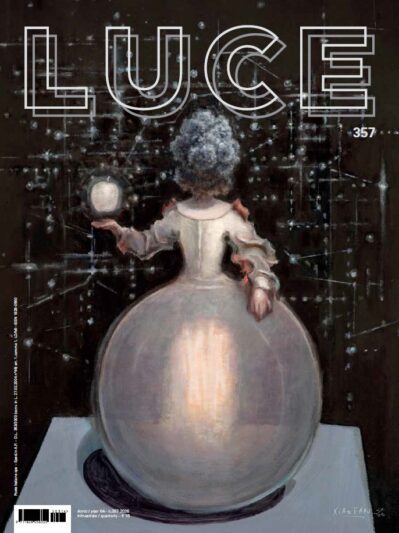
Cover image specially created for LUCE by the artist Fernando De Filippi
€18,00
10 disponibili
In this issue:

INTERVIEWS
Fernando De Filippi: “If I were fire, I would light spaces of beauty”
by Jacqueline Ceresoli
The cover of this issue of LUCE was created by Fernando De Filippi, a visionary artist who, in a career spanning more than 50 years, has built a personal and professional path that has made him one of the most prominent figures in Italian and international art. Fire, an element often used by the Salento-born artist in his works, represents par excellence the concept of transformation, of change not only from a physical and physiological point of view, but also from an emotional point of view. Fire, with its perpetual movement, makes it possible to change state and shape, a meaning that thus becomes significant and can also be associated with the element of light. “What I have chosen to develop in this research phase is the image of the flame as a changing and endless perceptual experience, or a process of subjective interpretation of the vision of the world – a metaphor of knowledge that is not satisfied with descriptive forms, but seeks to unveil the hidden realms of existence and of meanings themselves,” De Filippi told us in the interview we did with him.

ARCHITECTURE AND DESIGN
Lino Tagliapietra: “The objects I create are animated by light”
by Pierluigi Masini
We can consider glass to be much more than a material – it is a sensory bridge that combines functionality and emotion. This is what master glassmaker Lino Tagliapietra, who has received numerous international accolades for his art, especially in America, explains in his interview. For him, glass is shape, colour and magic, to be shaped with respect, and light is an essential element that brings out colours, reflections, shades and transparencies. “Once you’ve achieved it, that shape truly becomes part of you. Take the glass with your hands, and with a simple piece of paper you can modify it – it’s magical. With glass, you have to know how to use your breath, your hands, you have to collaborate with it and respect it. If you don’t, the glass will somehow punish you…”

ARCHITECTURE AND DESIGN
Light as thought in the projects of Studio BIG
by Monica Moro
We met Jakob Lange, project leader and expert in design, technology, and lighting, who has been a partner at BIG for over 22 years. The studio founded by Danish architect Bjarke Ingels boasts a large team of architects, designers, and thinkers who deal with the design, planning, research, and development of new concepts, uses, and shapes. BIG is known for its unique design philosophy that combines environmental awareness with the aesthetic appeal of spaces. Jakob Lange tells us about his relationship with light and the vision behind the studio’s major projects.
“In the Stone Age, when humans were still in their primitive stage, they lived in caves and followed the natural rhythm of the sun and the light outside. Then, at some point, they learned how to make a fire, it was a big leap forward, allowing humans to illuminate their caves at night, thus extend the length of the day. Today, we have gained control over the “medium” of light and can create light in any situation. At BIG, when we create light, we want it to be as effortless, easy, and integrated as possible. If this is not possible, then it should feel inspiring. I feel that designing a source of lighting without expressing the intelligence of thought that is behind it is just a wasted opportunity…”

ARCHITECTURE AND DESIGN
Techne and Poiesis in the design of Denis Santachiara
by Paolo Calafiore
In the contemporary Italian design scene, few designers are able to evoke the synthesis between poetic research and innovation offered by the potential of technology as effectively as Denis Santachiara. A visionary designer with a wide-ranging, surprising, and futuristic output, in 2022, in Milan, he was awarded an honorary degree in product design from the Brera Academy. A talented child prodigy, Denis Santachiara gained his first experience in the heart of Emilia’s Motor Valley and, at the age of just 16, joined De Tomaso (a historic car manufacturer, ed.) as a car designer, immediately expressing a strong interest in technology, which he later transferred to other areas of design, particularly the design of lighting fixtures. In this field, at a time when nobody was even thinking about it, he redefined and recoded domestic lighting, transforming lamps from simple functional tools into metaphors – changeable and emotional shapes able to trigger the imagination – or, in other words, light’s dreamlike, symbolic, and behavioural value and psychological influence…

DESIGNING LIGHT
The light of the third millennium: miniaturisation, integration and connection
by Silvio De Ponte
Within the project, light once again becomes a building material capable of creating virtual spaces and magical atmospheres. This is the right approach for the information age, which requires low luminance and attenuated reflections in order to make its phosphors visible. The functions go beyond the aesthetic design of the object. Lighting systems and fixtures are no longer only providing light, but also offer new services based on the interrelationship between objects and people. Thanks to the advent of these technologies, the “reduction” in size of light sources, and the improvement of their luminous performance, lighting products will increasingly be integrated into the structural parts of furnishings or into the architecture itself – whether external or internal – in walls, floors, ceilings, or other elements of architectural space.
We will have luminaires with many more technologically advanced features integrated into the light source, such as adaptive intelligence and wireless connectivity, with more powerful sensors and flow control systems. Miniaturisation and building-integrated lighting also play an important role. Miniaturisation in the field of lighting allows light sources to be integrated into the building – both indoors and outdoors – to the point where they almost disappear completely. Light thus becomes an intangible material for invention…

DESIGNING LIGHT
A casket of light
The Oreade restaurant in the Tuscan hills
by Nancy Tollins
Opened this year in the heart of Italy, the Oreade restaurant, designed by Foster + Partners, is a “jewel” project that enriches the precious offering of Monteverdi Tuscany, a hotel scattered across the Tuscan hills of Val d’Orcia. A long dirt road leads to the destination. Crossing the threshold of a medieval building carved into the rock, you encounter two rooms, one of which features a large table, the table de chef, suitable for convivial shared dinners, while the other is equipped with three intimate seating areas for tête-à-tête evenings, for a total of only fourteen guests. Foster + Partners has created an intimate and cosy place with an extraordinary atmosphere, while also pursuing goals of low environmental impact and sustainability. Many of the furnishings have been created by giving new life to recycled materials and objects, recalling the principles of the Italian arte povera movement typical of the 1970s. Light is one of the essential “ingredients” of the restaurant and required a lighting design that went beyond simple illumination to become an integral part of the sensory journey. The aim was to evoke a feeling of intimate discovery, where each dish was presented as a work of art and every conversation seemed like a shared secret…

DESIGNING LIGHT
Lighting variations for worship places
The churches of Højvangen and Soboras
by Nancy Tollins
In this article, we discuss the lighting of the churches of Højvangen and Soboras. These are two very different places of worship, but both are immersed in the cold landscapes of Northern Europe and feature extraordinary lighting design.
In the Danish town of Skanderborg, the new church of Højvangen has recently been completed. It was designed by the Danish architectural firm Henning Larsen, in collaboration with Norwegian architect Espen Surnevik. Højvangen represents a new vision of the place of worship, a building that welcomes the faithful in an updated and contemporary way, conceived as a liturgical space open to the community, equipped with the flexibility necessary to host cultural events and gatherings, while offering small areas for contemplation both indoors and outdoors. Here, artificial lighting unifies the space without overwhelming the serene atmosphere that is key to this place. The light works in synergy with the materials present, and together they create a warm, welcoming atmosphere, a spirituality that embraces humanity, with an almost domestic quality, in line with the tradition of Scandinavian design that contrasts the harsh climate with the warmth and light of the hearth.
Another example of lighting design is the Soboras Church in Kaunas, Lithuania, also known as St. Michael the Archangel Church. Here, the lighting design focuses on the exterior of the building and is integrated into a pre-existing historic place of worship. The concept was developed by the designers at Energy Green, a Lithuanian design company that won the LIT Lighting Design Award for Best Heritage Lighting Design…

LIGHTING DESIGNERS
Mariel Fuentes: “Lighting should not eliminate the night, but rather accompany it”
by Ann-Marie Baculard
We met Mariel Fuentes, Chilean architect and lighting designer, co-founder, with Michela Mezzavilla, of the multicultural studio MMAS Lighting in Barcelona, Spain, dedicated to architectural lighting, “it’s a language that complements architecture,” as defined by Mariel Fuentes. “It is a discipline that explores how to interpret and express values through light in all its forms, while responding to the various needs related to its use. The role of a lighting designer in this case involves both social and professional responsibility. A well-thought-out lighting approach can truly reveal the full potential of a space or fail to do so. This is because light is a technical tool that has profound emotional implications. It has the ability to evoke emotions directly. Light is an incredibly powerful stimulus in terms of neuro-perception, and most users are not even aware of it. That is why it becomes such an effective tool for shaping experiences…”

SPECIAL REPORT
Light and sport
articles by GianPiero Bellomo, Elisa Belloni, Cristina Rivadossi
This issue’s special report is on the role of lighting in sport. In the world of sport, light isn’t just a technical element, but a silent protagonist that affects every aspect of sporting events: from safety to performance to the immersive experience of spectators, helping to create a comfortable atmosphere for athletes and officials and an engaging one for spectators.
It is thus a complex field, given all the different variables to be considered for each discipline and each project context, which we describe and explore in depth with the help of experts and professionals…

SUSTAINABILITY
Illuminating cities with sunlight
A journey around the world
by Ann-Marie Baculard
Imagine walking through a city just after sunset – the glow of the streetlights casts a warm, welcoming light on the pavements and busy streets, and along your way you pass quiet alleys and squares bustling with people. Now, let’s imagine the same scene, but instead of the ordinary streetlights we’re used to, powered only by classical electricity grids, the city is lit by the sun, harnessed through stylish solar panels built into the streetlights themselves. This is not a distant dream, but a reality that is rapidly spreading around the world: from Europe to North America, Asia and Africa, solar-powered street and urban lighting is transforming urban landscapes, making them smarter, greener and more sustainable…

LIGHT ART
Marinella Senatore: “Light creates spaces for sharing”
by Cristina Tirinzoni
We encountered Marinella Senatore, a multidisciplinary artist born in Cava de’ Tirreni, trained in music, fine arts, and cinema. A “process activator” (as she describes her role as an artist), she has found in the dynamics of sharing and participation, through the language of light, the cornerstone of her innovative and revolutionary artistic research, aimed at generating social change. She has transformed traditional lighting, a symbol of southern Italian festivals, into large light installations that create spaces for sharing, dialogue and a sense of belonging to the community. Both a revolutionary artist and a process activator, she believes that art can still be provocative in these confusing times. “Art can and must be a form of resistance. In an increasingly polarised and conflictual world, my practice stands in stark opposition to these dynamics, proposing another vision – one of social cohesion, of valuing each person’s uniqueness and of individual flourishing within a collective body…”

RESEARCH AND TECHNOLOGY
Hiroshi Amano: “In the future everyone will be able to use high-level generative artificial intelligence”
by Elisa Belloni
We met Professor Hiroshi Amano, who in a short interview tells us about the stages of his important discoveries and the future scenarios he envisages for the global energy transition. A world-renowned scientist, he won the Nobel Prize in Physics in 2014 for inventing blue light-emitting diodes (LEDs). Last April, the University of Milan-Bicocca awarded him an honorary degree in Science and Nanotechnology for Sustainability. Professor Amano is currently director of the Centre for Integrated Research on Future Electronics and professor at the Institute for Materials and Systems for Sustainability at Nagoya University in Japan. In this capacity, he is engaged in the development of new technologies for the production of high-efficiency semiconductors and innovative energy-saving devices. The goal of these efforts is to facilitate the transition to a more sustainable economic model…

LIGHT ON THE RIGHTS
LightingEurope: EU-wide harmonised regulations on artificial lighting at night
by Elena Scaroni
Few topics in the world of lighting have been discussed with as much passion as artificial light at night (known as ALAN). LightingEurope, the association representing lighting manufacturers in Europe, recently published a position paper calling for a harmonised EU regulatory framework on ALAN. Well-designed lighting systems using quality products and control systems are essential for creating the right environment at night. We illuminate for human beings and their visual spectrum needs. However, in all lighting applications, it is also necessary to consider the effect on the natural environment, including fauna and flora, as well as the effects of obtrusive light, sky glare and light pollution. It is a matter of striking a balance between human and environmental needs. Although technology has advanced rapidly and modern LED systems offer precision optics, spectral tuning and intelligent controls, much of Europe’s outdoor lighting infrastructure remains severely outdated. Street lighting products, for example, can operate for over 40 years, indicating that public lighting in Europe is still far from being up to date. A similar misalignment can also be found between regulations and standards…
In LUCE 353 / 2025 you will find many other articles, interviews and in-depth features.
We are always on the lookout for new suggestions and ideas for understanding, explaining and publicising the world of Italian and international lighting.
Keep reading and writing to us!
A window on the world
by Mariella Di Rao
The Polo Museale Liberiano of the Papal Basilica of Saint Mary Major receives a new lighting
by Federica Capoduri
Illuminate textiles like a pro
by Gaia Fiertler
Oscar Frosio: “Today, you can sometimes say that light alone makes theatre”
by Cristina Ferrari
Functional lighting for sports fields
Features, standards, and technologies
by GianPiero Bellomo
Sport goes green: the impact of energy efficiency in sports facilities
by Elisa Belloni
Sport in the spotlight: when light makes the difference
by Cristina Rivadossi
Quality urban lighting for social sustainability
by Marco Frascarolo
Lights of the Renaissance
The Darkscape Experience Project
by Ivanka Yordanova Dicheva, Andrea Siniscalco
The Fenix Museum: art, light, and architecture to tell the phenomenon of migration
by Paola Testoni
Lydia Ricci: light, memory and forgotten objects
by Sabino Maria Frassà
Architecture and transparency
Glass as a metaphor for modernity
by Alessandro Marata
Gae Aulenti. “The” Gae
by Giulia Ottavia Silla
Playing with space: Linea Light Group’s linear Node System
by Cristina Ferrari
Light for smart road infrastructure: the Edge system by LumeItalia
by Cristina Ferrari
Thesis publication “Light as a trace of time for the Capece Minutolo Chapel”
by the Editorial Team
GEN Z LIGHTS
by Deborah Madolini (storyboard), Alberto Philippson (drawings)