LUCE 354-en
YEAR 63
June 2025
Magazine founded in 1962 by AIDI
Editor-in-Chief Mariella Di Rao
Clicca qui per la versione in italiano
Contacts for back issues:
phone +39 02 87389237
e-mail [email protected]
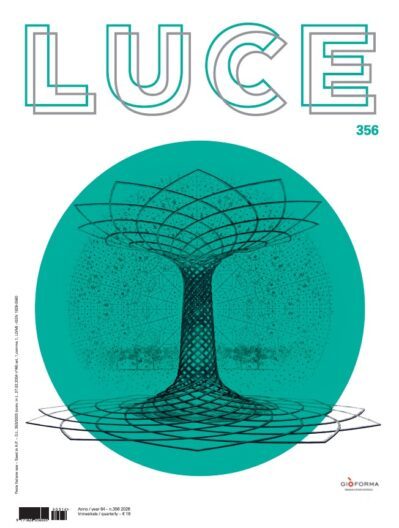
The Tree of Light, image specially designed for LUCE by director of photography Pasquale Mari. Cover photo copyright: FRANA. With thanks from Pasquale Mari to Patrizio Esposito for the cover design.
€18,00
14 disponibili
In this issue:

EDITORIAL
The Tree of Light
by Pasquale Mari
The cover of this issue of LUCE was created by master lighting designer Pasquale Mari – a director of photography who has created lighting for major theatrical and film productions and worked with renowned directors such as Mario Martone and Andrea De Rosa. In a text, the Maestro tells us the genesis of this cover, which he called “The Tree of Light,” and was inspired by the staging he created for the play Orlando, directed by Andrea De Rosa and starring the talented Anna Della Rosa… “Orlando’s light is the white light of a radiant morning sky. The light of Orlando is the white light of a sheet of paper, before you start writing. These are the thoughts that guided the arrangement of the cluster of projectors among which rises the sturdy trunk of a tree without crown, as poetically designed by Giuseppe Stellato. In fact, they are both the foliage and the sky under which Orlando, Virginia, Anna and her audience are captivated in listening to her. I like to think that all that white light condenses and reaches the ground, transforming itself into paper, into many white sheets waiting for words to turn into signs…”

INTERVIEWS
Space traffic that turns off the stars
by Gaia Fiertler
“Low-altitude satellites to reduce transmission latency in satellite communications and low-cost, energy-saving LED lights, indiscriminately directed upwards, are serious sources of light pollution, with impacts both on the human, animal and plant ecosystems and on astronomical research.” This is what Piero Benvenuti, professor emeritus of astrophysics at the University of Padua and director of the Centre for the Protection of Dark and Quiet Skies from Satellite Constellation Interference (CPS) of the International Astronomical Union (IAU), based in Paris, explains in this interview. Light pollution reaches the stars with various consequences: night-time luminescence from urban centres lit up like daylight and visible hundreds of kilometres away, nocturnal insects fleeing to more natural ecosystems, and an increase in insomnia and depression…

ARCHITECTURE AND DESIGN
Inclusive and sustainable architecture in SOM’s projects
by Monica Moro
We met with Colin Koop, Partner at Skidmore, Owings & Merrill (SOM), a renowned US architectural firm with over 80 years of activity. Koop is recognised for his leadership in numerous significant projects across various sectors, including education, transportation, culture, workplaces and urban planning around the world and even a habitat on the Moon. Among his most recent design projects is the Milan 2026 Olympic Village. The Village was designed with a long-term vision, and the studio is also overseeing its post-Olympic redevelopment. Light plays a fundamental role in this project, as the aim was to create a space that would attract people inside. The use of night-time lighting reflects the idea of landscape that characterises the entire project, creating a sort of “luminous beauty.”

ARCHITECTURE AND DESIGN
The new frontier of “sensitive” and integrated lighting design by Elisa Orlanski Ours
by Monica Moro
The “Big Apple” is truly a hotbed for architecture, especially for its skyscrapers, real modern towers that make its skyline unmistakable and help create its face, which is also shaped by numerous professionals, including Elisa Orlanski Ours, designer and professor, founder of the Planning & Design department at Corcoran Sunshine, an American company active in the planning, design, and sale of new luxury residential complexes, offering its consulting services from South Korea to Argentina, from the United States to the Caribbean. The designer explains her approach to lighting design and the use of new technologies. “For us, lighting is not something that is added at the end of the design process, but an integral part of a building’s DNA from day one. It defines the atmosphere even before the finishes or furnishings are in place, it guides people, evokes emotions, tells stories and creates connections. A lighting designer knows very well that it is not just a matter of choosing more or less elegant lighting fixtures, but of knowing how to create atmosphere, identity and memory. We involve them from the earliest stages… Sustainability and smart cities are recurring themes in every project, but the best projects go deeper. Technology helps us make smarter decisions in the pre-development phase: studies on solar radiation guide tower and pool placement, so as to design buildings that are not just beautiful, but also liveable and marketable…”

DESIGNING LIGHT
A journey through images
The new lighting for the Vatican Necropolis
by Giulia Ottavia Silla
The Vatican Necropolis‘s new lighting, designed by architect and lighting designer Alessandra Reggiani, was made to create a real physical, visual, and emotional story that mixes light and matter, keeping in mind the limits and challenges of this unique place and its historical and sacred importance. The new lighting system for the Vatican Necropolis, completed at the end of January 2025, is intended to visually and museographically redevelop the fascinating and complex underground space that winds its way through a journey of knowledge, culture and faith beneath St. Peter’s Basilica and the Sacred Vatican Grottoes. Osram and Zumtobel teamed up with architect and lighting designer Alessandra Reggiani to create the lighting design, which took full advantage of the major benefits of LED technology and – in a broader sense – electronics applied to the world of lighting, which allows “light matter” to become increasingly akin to a real architectural material, consisting of a compelling combination of technical and material aspects and an emotional, psychological and sensory response…

DESIGNING LIGHT
Shape meets imagination at Chiaia metro station in Naples
by Nancy Tollins
The new Chiaia station on line 6 of The Naples Metro is a descent – and ascent – from the underworld to the heavenly kingdom in a pagan key, unlike Dante’s Divine Comedy. It is an architectural and art project inspired by Greek and Roman mythology, full of atmosphere and colour. The architectural work, which takes the form of a giant “telescope” in the underground building, channelling light into the “belly” of the earth, was designed by architect Uberto Siola, Professor Emeritus of Architectural and Urban Composition at the Faculty of Architecture in Naples and Member of the Technical-Scientific Committee for Architectural and Landscape Heritage of the Italian Government. Responsible for the artistic intervention of the entire interior are the renowned British director, architect, screenwriter and filmmaker Peter Greenaway and Dutch artist and director Saskia Boddeke…

DESIGNING LIGHT
Designing light for healthier and more productive work environments
by Silvio De Ponte
In the near future, offices will be hybrid and flexible spaces, designed for human interaction rather than individual work. Assigned desks will disappear, replaced by mobile workstations that can be booked via an app, with integrated technology for immersive video conferencing and augmented reality. The environments will prioritise well-being and relationships, with circadian lighting, monitored air quality, biophilic green areas and spaces for meditation and fitness, all activities that, when practised, tend to improve work and professional “performance”. Architecture will be modular and reconfigurable, with movable walls that adapt spaces to the needs of the moment. IoT sensors will optimise temperature, noise and occupancy in real time. Collaborative areas will be central: informal lounges, shared kitchens and brainstorming rooms with interactive walls. Sustainability will be intrinsic: zero-energy buildings, recycled materials and rainwater harvesting systems. AI will manage bookings, individual preferences and energy consumption. There will be an increase in quiet spaces for deep concentration, alternating with lively areas for socialising…

DESIGNING LIGHT
A scenography of light
The new artistic lighting of Trajan’s Markets
by Federica Capoduri
The lighting renovation of Trajan’s Markets was completed a few months ago, marking the rebirth of a monument that plays a main role in the nocturnal perception of Rome’s archaeological landscape. In this interview, Marco Frascarolo, project manager and scientific coordinator for Roma Tre University, and Bruno Lalli, head of Areti’s Artistic Lighting Design unit, discuss the project. The work, which was funded by Roma Capitale’s Department of Infrastructure and Public Works, faithfully, beautifully and fully enhances the true appearance of the Markets, creating a fascinating urban vision from both a historical and contemporary perspective. Under the coordination of Prof. Marco Frascarolo and the Areti team, the collaboration on the project was based on a previous in-depth study carried out with the support of the Department of Architecture of Roma Tre University in agreement with the Master’s Degree in Lighting Design at Sapienza University of Rome, thanks to a collaboration with Areti that began in 2019.

LIGHTING DESIGNERS
The holistic and multisensory light of Alberto Pasetti Bombardella
by Mariella Di Rao
For architect and lighting designer Alberto Pasetti Bombardella, lighting design is a complex process involving knowledge of and attentiveness to the cultural sites of our artistic heritage that are to be illuminated. His design method begins with analysis involving cognitive processes and the integration of artificial and natural light. It is precisely the latter that marks the beginning of his creative process and that of his collaborators, which he always makes a point of mentioning whenever he describes his projects. We met him in his native Venice, where you can see how much this city, with its atmosphere, its silence, its colours, its light and its water, has shaped his soul and his work. His passion for light is long-standing, dating back to his childhood when a sparkle on the water of the Giudecca Canal gave him a strong feeling of immersion in light, awakening his interest and desire to explore this wonderful element and interpret it through a process rich in meaning and significance…

SPECIAL REPORT
Light and food
articles by Daniela Colli, Chiara Testoni
This issue’s special report is dedicated to the role of lighting in food. What is the relationship between light and what we eat, how should restaurant spaces be interpreted and designed, and what do top chefs – like Davide Oldani, with whom we had an interview – need? These are some of the questions and topics addressed here. What’s more, light today is also becoming a nutritive infrastructure and a sensory stimulus that redefines the relationship between man, the environment and food with efficient, sustainable and emotional solutions that we tell about through many national and international experiences.

RESEARCH AND TECHNOLOGY
Light and shadows in our homes
The search for a rare balance
by Andrea Siniscalco, Jordi Saladié y Carbonell, Silvia Garrone
Far from criticising the modern “culture of light” (or the total lack thereof), the purpose of this article is, on the contrary, to share some insights about that protected corner where we may seek refuge (at least in part) from the “lights of modernity”, i.e. our home, or the so-called “residential environment.”
In Italy, the reference standard is UNI/TS 11826:20218, which, however, only provides recommendations on the type of lighting fixtures and illuminance levels for the most “sensitive” areas of the home (such as kitchen worktops), referring to UNI EN 12464-19 for parts relating to domestic work activities. There are no particularly restrictive standards for residential spaces, but also UNI/TS 11826:2021 underlines that light (colour temperature) can influence circadian rhythms.
Certainly, everyday practical tasks such as studying, playing or eating meals require comfortable levels of light, but a poor understanding of how light affects us through non-image-forming channels often leads to the installation of excessive and uncontrolled light flows, without paying attention to the well-being that should be promoted in our homes…

LIGHT ART
The cosmic, polychromatic and “Renaissance” light of Donatella Schilirò
by Jacqueline Ceresoli
Widely acclaimed for her ability to combine production with colour experimentation, Donatella Schilirò stubbornly pursues the renewal of techniques and secrets of neon and argon processing with her mostly site-specific art works, which are inspired by the Cosmos and constellations, and materialise luminous paths of imaginary journeys between Earth and Sky. Her imaginative maps that create a magical and alienating vision are made with flame-bent glass neon tubes – germinating coloured materials used to reconnect man with the planets, where everything is a discovery of universal harmony and respect for the environment. The year 1947 saw the birth of the Manifesto of Spatialism, drafted by philosopher Beniamino Joppolo, multifaceted artist Lucio Fontana, critic Giorgio Kaisserlian and writer Milena Milani. The aim was to move beyond the two-dimensionality of paintings, creating a new form of art open to the integration of new technologies, for an “aerial, universal and suspended” aesthetic, using non-traditional materials. The luminous works change the perception of space and time and, through colour and lines, define new dynamic spatialities…

LIGHT ON THE RULES
How the EU can close loopholes in online product compliance
by Elena Scaroni
The volume of direct-to-consumer imports from Third countries, outside the EU, continues to rise. According to the European Commission’s February 2025 communication “E-commerce Communication: A Comprehensive EU Toolbox for Safe and Sustainable E-commerce”, 4.6 billion small parcels – those valued under €150 – entered the EU market in a single year. Therefore, LightingEurope believes that urgent and clear political and legislative actions from the EU Institutions and Member States are urgently needed.

ASSOCIATIONS
Laura Bellia: “Young people are our future. Let’s not dampen their enthusiasm”
by Mariella Di Rao
Laura Bellia, full professor of Technical Physics at Federico II University in Naples and President of AIDI (Italian Lighting Association), reappointed for the next two years, tells us in an interview about the Association’s topics and plans for the next two years…
In LUCE 354 / 2025 you will find many other articles, interviews and in-depth features.
We are always on the lookout for new suggestions and ideas for understanding, explaining and publicising the world of Italian and international lighting.
Keep reading and writing to us!
A year of LUCE between innovation and tradition
by Mariella Di Rao
Stefan Diez’s circular and sustainable light
di Nancy Tollins
Where light guides the future
by Cristina Rivadossi
The project as dialogue
The story of a collaboration between light and emotional landscapes
by Federica Capoduri
Gianni Pollini: “Light shows its true splendour in darkness”
by Cristina Tirinzoni
Light as a sensory composition
by Daniela Colli
Davide Oldani: “Food is the light that comes from the heart”
by Chiara Testoni
Feeding on light
by Chiara Testoni
Living Bento
When light makes food “pulse”
by Chiara Testoni
Agrifood 4.0
Opportunities and risks of advanced agrivoltaics
by Gaia Fiertler
Light in search of infinity
The photography of Davide Tranchina
by Sabino Maria Frassà
Private initiative PPPs. Design simplification in the Corrective to the Public Contracts Code
by Alberto Scalchi
The beauty of turning thirty
ASSIL’s pledge to the future
by Pietro Mezzi
Words of Light
by Alessandro Marata
When light becomes word
by Pierpaolo Arcangioli
Targeted lighting combining advanced functionality, aesthetics,
and sustainability: the Olo bollard by L&L Luce&Light
by Cristina Ferrari
Advanced sensors are making public lighting “smart”
The innovation from DigitalPlatforms & UMPI
by Cristina Ferrari
Thesis abstract “The evolution and impact of Integrative Lighting on design practice”
by the Editorial Team
GEN Z LIGHTS
by Deborah Madolini (storyboard), Alberto Philippson (drawings)